Industrial Megaprojects Are Redefining the Future of Architecture—And BIM Professionals Are Leading the Transformation

Updated: Jul 17
By Georgina Anahi Sosa Farfán

Architecture Is Entering a New Era
The world's most ambitious construction projects are no longer iconic skyscrapers or landmark museums.
Today, the largest investments are flowing into semiconductor fabrication plants, electric vehicle manufacturing facilities, battery gigafactories, pharmaceutical campuses, and advanced manufacturing complexes. According to the Semiconductor Industry Association (2024), more than $500 billion in semiconductor manufacturing investments have been announced worldwide in recent years, while the U.S. CHIPS and Science Act has accelerated the development of dozens of new fabrication facilities across the United States.

These projects represent a level of technical complexity rarely seen in traditional building construction.
Millions of components.
Thousands of kilometers of electrical systems.
Hundreds of specialized contractors.
Compressed schedules.
Strict quality standards.
Zero tolerance for coordination errors.
In this environment, construction is no longer driven primarily by drawings.
It is driven by information.
And that shift is fundamentally redefining the role of architecture.
The Productivity Challenge Construction Has Been Trying to Solve
Despite representing nearly 13% of the global economy, construction remains one of the least digitized major industries.
According to McKinsey & Company, labor productivity in construction has grown by only about 1% annually over the past two decades, significantly below manufacturing, which has achieved productivity growth rates exceeding 3% per year (McKinsey, Reinventing Construction, 2017).
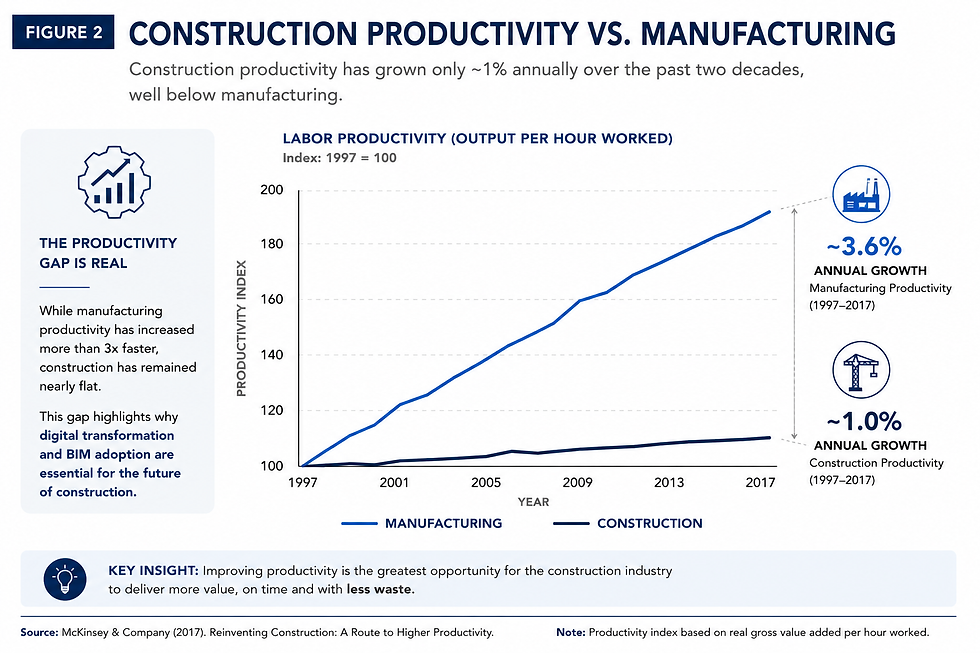
At the same time, the World Economic Forum identifies digitalization as one of the most critical enablers for improving infrastructure delivery, reducing project risk, and increasing sustainability across the built environment.
The conclusion is clear:
The challenge facing construction is no longer how to design buildings.
It is how to manage exponentially increasing project complexity.
BIM Is No Longer a Design Tool
One of the biggest misconceptions about Building Information Modeling (BIM) is that it is simply advanced 3D modeling.
That definition became outdated years ago.
In today's industrial megaprojects, BIM functions as a collaborative information ecosystem where architects, engineers, contractors, fabricators, owners, and field teams work from a shared digital environment throughout the project lifecycle.
The model is only the visible layer.
The real value lies in the information.
Every coordinated system reduces uncertainty.
Every validated model prevents field conflicts.
Every digital review minimizes costly rework.
According to the National Institute of Standards and Technology (NIST), inadequate interoperability has historically generated more than $15 billion annually in avoidable costs across the U.S. capital facilities industry.
For industrial projects operating under aggressive schedules, avoiding a single coordination failure can translate into millions of dollars in savings.
This is why BIM has evolved from a visualization technology into a strategic project delivery methodology.
Industrial Construction Has Changed the Definition of an Architect
For decades, architecture education has focused primarily on design, spatial composition, and technical documentation.
Those competencies remain essential.
But industrial megaprojects require something more.
They require professionals capable of integrating information across multiple disciplines while understanding how every design decision impacts fabrication, procurement, construction sequencing, commissioning, and ultimately project performance.
Leading BIM coordination efforts within large-scale industrial construction has reinforced one consistent observation:
Technical excellence alone is no longer enough.
The professionals creating the greatest value are those who can translate engineering intent into coordinated digital workflows that enable better decisions across the entire project team.
This represents a profound evolution in the architect's role.
Architects are increasingly becoming information managers, digital coordinators, systems integrators, and strategic contributors to project execution—not solely designers of physical spaces.
Why BIM Coordinators Are Becoming One of Construction's Most Valuable Professionals
The rapid growth of advanced manufacturing projects across North America has intensified demand for professionals who understand both technology and construction.
Organizations such as the American Institute of Architects (AIA) and the National Council of Architectural Registration Boards (NCARB) have consistently emphasized the growing importance of digital competencies within architectural practice.

Meanwhile, the U.S. Bureau of Labor Statistics projects continued demand for architecture and construction professionals capable of working with emerging technologies and integrated project delivery methods.
Yet software proficiency alone is no longer a competitive advantage.
The market increasingly rewards professionals who can combine:
Digital modeling
Information management
Construction knowledge
Interdisciplinary communication
Risk identification
Project coordination
Leadership
These capabilities cannot be automated.
They become exponentially more valuable as projects become more complex.
The Opportunity Extends Far Beyond the United States
Many countries are still in the early stages of BIM adoption.
For architects and engineers willing to specialize, this represents an extraordinary opportunity.
The global construction industry is no longer hiring professionals based solely on geographic location.
It is hiring expertise.

Remote collaboration, cloud-based project environments, and digital coordination platforms have created a global market where specialized knowledge frequently matters more than physical presence.
For young architects, particularly those passionate about digital modeling, BIM offers something unique:
A career path that extends well beyond producing drawings.
It offers the opportunity to influence how some of the world's most technologically advanced projects are planned, coordinated, and delivered.
The Future Belongs to Digital Project Leaders
Artificial intelligence, automation, reality capture, digital twins, and predictive analytics are already transforming project delivery.
BIM sits at the center of this transformation.
Not because it is another software platform.
But because it provides the structured information that every emerging technology depends on.
The next generation of construction leaders will not be defined by the software they know.
They will be defined by their ability to integrate people, information, technology, and execution into a single digital ecosystem.
That evolution has already begun.

The architects who recognize it today will help shape the next generation of industrial construction.
References
American Institute of Architects. (2024). Architecture Firm Survey Report.
Eastman, C., Teicholz, P., Sacks, R., & Liston, K. (2018). BIM Handbook: A Guide to Building Information Modeling (3rd ed.). Wiley.
McKinsey & Company. (2017). Reinventing Construction: A Route to Higher Productivity.
National Council of Architectural Registration Boards. (2024). NCARB by the Numbers.
National Institute of Standards and Technology. (2004). Cost Analysis of Inadequate Interoperability in the U.S. Capital Facilities Industry.
Semiconductor Industry Association. (2024). 2024 State of the U.S. Semiconductor Industry.
U.S. Bureau of Labor Statistics. (2024). Occupational Outlook Handbook: Architects.
World Economic Forum. (2023). Shaping the Future of Construction.


Comments