Korean Investment Is Reshaping America’s Industrial Landscape—And Construction Professionals Must Learn to Work Across Cultures

Updated: Jul 18
From semiconductor fabs and solar manufacturing campuses to battery plants and electric-vehicle factories, South Korean companies are helping define a new generation of industrial megaprojects in the United States.
By Georgina Anahi Sosa Farfán

Over the past five years, some of the most consequential construction sites in the United States have emerged far from the traditional skylines of New York, Chicago, or Los Angeles.
They are rising instead in places such as Taylor, Texas; Cartersville and Dalton, Georgia; Commerce, Georgia; and other rapidly transforming industrial corridors across the South and Midwest.
On these sites, hundreds of cranes, thousands of workers, complex utility networks, highly controlled manufacturing environments, and multinational supply chains converge around a common objective: building the infrastructure required for the next era of American manufacturing.
Behind many of these projects is a major force that has not received enough attention within the architecture, engineering, and construction industry:
South Korean industrial investment.
Companies such as Samsung Electronics, Hanwha Qcells, Hyundai Motor Group, SK Group, and their extensive networks of suppliers and specialty contractors are no longer simply selling products in the United States. They are constructing entire industrial ecosystems.
Samsung initially committed at least $17 billion to its advanced semiconductor fabrication facility in Taylor, Texas—the company’s largest investment in the United States when it was announced in 2021. The broader development includes highly specialized manufacturing, infrastructure, equipment, utilities, and supporting facilities designed for advanced logic-chip production.
In Georgia, Hanwha Qcells announced an investment exceeding $2.5 billion to expand its Dalton operation and develop a vertically integrated solar-manufacturing supply chain in Cartersville. The initiative was projected to increase the company’s U.S. production capacity to 8.4 gigawatts and create thousands of clean-energy jobs.
These are not isolated factories.
They are complex physical manifestations of a broader geopolitical and industrial realignment—and they are redefining how megaprojects are designed, coordinated, constructed, and managed.
A New Phase of Korean Investment in the United States
Economic cooperation between South Korea and the United States is not new. Korean companies have operated American manufacturing facilities for decades.
What has changed is the scale, strategic relevance, and technical complexity of the latest investment cycle.
The projects announced since 2021 are concentrated in industries that the United States now considers essential to its economic resilience and national security:
Semiconductors
Solar-energy components
Electric-vehicle batteries
Advanced automotive manufacturing
Electronic materials
Artificial-intelligence infrastructure
Clean-energy supply chains
Samsung’s expansion in Central Texas illustrates this shift. In 2024, the U.S. Department of Commerce announced preliminary terms for up to $6.4 billion in CHIPS Act incentives connected to Samsung’s planned semiconductor ecosystem. At that time, the proposed program was expected to leverage more than $40 billion in private investment and support more than 17,000 construction jobs and 4,500 manufacturing jobs over the following years.
SK Group announced in 2022 that its companies planned an additional $22 billion in U.S. investments across semiconductors, clean energy, and bioscience, on top of approximately $30 billion already committed through 2025.
Its activities include a $2.6 billion battery-manufacturing investment in Georgia, multibillion-dollar battery joint ventures in Kentucky and Tennessee, and a $600 million advanced semiconductor-materials facility developed by Absolics in Covington, Georgia.
Together, these projects demonstrate a fundamental change in the role of foreign direct investment.
Korean companies are not merely adding manufacturing capacity. They are bringing production systems, construction methodologies, management structures, supplier relationships, technical standards, and workplace cultures developed through decades of high-speed industrial growth.

The result is a new type of American construction environment: one in which local codes, U.S. labor practices, Korean corporate systems, global engineering standards, and project-specific technical requirements must operate simultaneously.

Qcells: Building More Than a Solar Factory
The Qcells development in Georgia represents one of the clearest examples of how Korean investment can influence an entire regional construction and manufacturing ecosystem.
The project was conceived not simply as another photovoltaic-panel assembly facility, but as a domestic supply chain extending from raw materials and intermediate components to finished solar modules.
That distinction is important.
A conventional manufacturing project may focus primarily on constructing a building and installing a production line. A vertically integrated manufacturing campus requires something more complex:
Multiple interconnected production stages
Large electrical and mechanical utility systems
Specialized chemical and material-handling infrastructure
Logistics and warehousing networks
Quality-control laboratories
Extensive automation
Environmental and life-safety systems
Future expansion capacity
Coordination with supplier facilities beyond the principal site

Qcells described its investment as the largest in U.S. solar-manufacturing history at the time of its announcement. The company’s strategy also generated secondary investments, including a $147 million facility intended to manufacture encapsulant material critical to the solar-panel supply chain.
This multiplier effect is one of the most significant characteristics of Korean-led megaprojects.
The principal factory attracts suppliers. Suppliers require warehouses, production plants, utility connections, transportation improvements, housing, services, and trained labor. What begins as a single capital project gradually becomes an industrial cluster.
For construction professionals, this means the opportunity extends far beyond the original building.
It creates demand for architects, engineers, BIM and VDC coordinators, construction managers, specialty contractors, commissioning professionals, safety specialists, controls engineers, planners, estimators, and digital-delivery teams.
Samsung Taylor: Construction at Semiconductor Scale
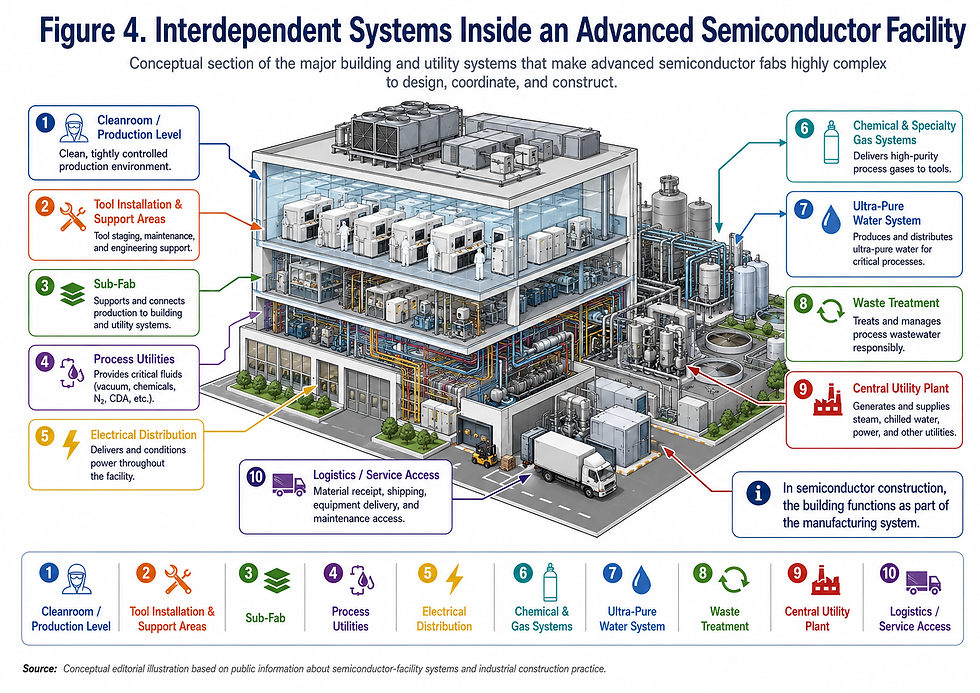
Semiconductor fabrication facilities belong to one of the most technically demanding categories of construction in the world.
They require levels of precision, cleanliness, redundancy, vibration control, environmental stability, power quality, water treatment, process integration, and documentation that exceed those of most commercial buildings.
Samsung’s Taylor investment illustrates this complexity.
The initial commitment included billions of dollars in buildings and real-property improvements, as well as approximately $11 billion in machinery and equipment.
That balance reveals an essential reality of semiconductor construction:
The building is not merely a container for manufacturing. It is part of the manufacturing system.
Every major discipline is interconnected.
Electrical distribution affects process equipment and production continuity. Mechanical systems affect temperature, humidity, contamination control, and tool performance. Structural decisions affect vibration. Utility routing affects maintainability, safety, installation sequencing, and future expansion.
A single coordination error can extend beyond a conventional field conflict. It may interfere with equipment installation, cable routing, process access, testing, commissioning, or operational reliability.
This is why digital coordination becomes central.
In an advanced industrial project, BIM is not only a visualization tool. It is a coordination environment where constructability, spatial allocation, fabrication, installation, inspection, commissioning, and operational information must be aligned.
The professionals leading these models are not simply drafting buildings.
They are helping manage an enormous network of technical dependencies.
The Korean Project-Delivery Culture
Understanding the physical scale of these investments is only part of the equation.
Professionals working on Korean-led projects must also understand the management culture behind them.
Every company is different, and no national business culture should be reduced to a stereotype. Nevertheless, recurring characteristics can often be observed in large Korean industrial organizations:
Speed is treated as a competitive advantage
Schedules may be extraordinarily aggressive. Engineering, procurement, construction, equipment installation, and field modifications frequently overlap.
Decisions that would occur sequentially on a conventional project may need to happen simultaneously.
This creates pressure, but it also encourages rapid problem-solving and strong production discipline.
Hierarchy influences communication
Authority, seniority, and organizational position may strongly affect how information is communicated and how decisions are escalated.
For professionals accustomed to flatter organizational structures, understanding who owns a decision can be as important as identifying the technical solution.
Field progress often drives immediate priorities
Long-term planning remains essential, but daily production needs can rapidly change the project’s focus.
A routing conflict, equipment modification, procurement delay, or installation constraint may require immediate drawing updates and coordination across several teams.
Documentation may move across multiple systems
A project can include Korean corporate standards, U.S. codes, owner requirements, subcontractor shop drawings, BIM models, XREF files, marked-up PDFs, field sketches, and rapidly revised construction documents.
The challenge is not simply producing more information.
It is maintaining a reliable chain of information.
Relationships and trust matter
Technical competence establishes credibility, but consistency, responsiveness, respect, and the ability to work across cultural and language differences often determine whether collaboration succeeds.
These characteristics can create a highly productive environment when supported by clear procedures. Without structured communication and document control, however, speed can amplify risk.
The Hidden Risk: When Construction Moves Faster Than Information
One of the defining challenges of industrial megaprojects is the gap that can develop between what has been designed, what has been approved, what has been issued, and what is actually being installed.
Consider a typical coordination scenario:
A revised conduit route is incorporated into the latest model or CAD reference. The associated shop drawing has not yet been updated. A field team continues working from an earlier printed wiring plan. Another contractor uses a sketch prepared from a different revision.
Each document may appear legitimate in isolation.
Together, they create a serious coordination failure.
The immediate issue may be a conduit, cable tray, pipe, duct, or equipment-access conflict. The larger issue is the absence of a clearly controlled source of truth.

On fast-moving projects, this problem is multiplied across thousands of components.
The solution is not simply asking teams to “coordinate better.”
It requires an information-governance system that establishes:
The current authorized construction reference
Responsibility for updating each drawing or model
Revision-identification protocols
Formal approval status
Distribution procedures
Traceability of field changes
Model-to-drawing consistency checks
A process for incorporating verified conditions into the as-built model
This is where BIM/VDC professionals can create value far beyond clash detection.
They can help transform fragmented documentation into a controlled decision-making environment.
BIM as a Cross-Cultural Coordination Platform
In multinational megaprojects, BIM also performs a role that is less frequently discussed:
It becomes a common technical language.
Project participants may speak different native languages and come from different professional cultures. Written explanations can be misunderstood. Terminology may vary across companies. Organizational hierarchy may make direct disagreement difficult.
A coordinated model can reduce some of that ambiguity.
It allows teams to point to a location, compare alternatives, visualize consequences, verify clearances, review sequencing, and communicate a proposed solution more objectively.
This does not eliminate the need for strong communication.
It makes communication more precise.
For BIM and VDC professionals, this creates a leadership opportunity. The most valuable coordinator is not necessarily the person who knows the greatest number of software commands.
It is the person who can:
Identify the real source of a coordination problem
Determine which document has contractual or technical authority
Explain the issue clearly to different stakeholders
Visualize the impact of each alternative
Maintain revision traceability
Convert a field condition into reliable project information
Protect constructability without losing sight of schedule and cost
In this environment, digital expertise must be combined with technical judgment, diplomacy, and cultural intelligence.
What Korean Megaprojects Are Teaching the U.S. Construction Industry
The influence of Korean investment extends beyond individual factories.
These projects are accelerating broader changes in American construction.
1. Industrial facilities are becoming technology platforms
Semiconductor, battery, solar, and advanced-automotive facilities integrate architecture, engineering, automation, data, manufacturing, and operations.
The separation between “building systems” and “production systems” is becoming increasingly difficult to maintain.
2. Design and construction must operate concurrently
Traditional linear delivery is often too slow for the required production schedules.
Teams must coordinate incomplete information while preserving enough control to avoid costly rework.
3. Specialty contractors are strategic partners
Electrical, mechanical, controls, process-piping, structural-steel, equipment-installation, and cleanroom contractors carry critical knowledge.
Their fabrication and field data must be incorporated earlier into project decisions.
4. Digital coordination is becoming operational infrastructure
BIM, common data environments, model-based coordination, reality capture, digital field reporting, and structured as-built information are no longer optional enhancements.
They are part of the project’s production system.
5. Cultural intelligence is becoming a technical competency
A technically correct recommendation can still fail when it is communicated through the wrong channel, presented without sufficient context, or escalated without understanding the organization.
The next generation of project leaders must know how to coordinate both systems and people.
A Professional Perspective from Inside Korean-Led Projects
Working within Korean-led industrial construction environments has reinforced an important lesson for me:
The most difficult problems are rarely caused by a complete lack of information. They are caused by information that exists but is disconnected, outdated, inconsistently interpreted, or communicated too late.
A model may be correct, but the shop drawing has not been revised.
A drawing may be current, but the field crew is using an earlier print.
A route may work geometrically, but it does not account for installation sequence.
A technical team may understand the issue, but the decision-maker has not received the information in a format that makes the risk clear.
Resolving these situations requires more than software proficiency.
It requires disciplined review, documentation, respect for the chain of command, technical clarity, and the confidence to identify inconsistencies before they become installed rework.
It also requires professionals who can operate between different worlds:
Design and construction
Office and field
Korean and American teams
Digital models and physical installation
Technical accuracy and schedule urgency
That interface is where BIM/VDC leadership becomes most valuable.
The Opportunity for Architects and Construction Professionals
Korean investment is creating more than employment.
It is creating a new professional specialization.
Architects and construction professionals who want to participate in advanced industrial projects should develop capabilities in several areas:
Industrial building systems
Understanding electrical distribution, mechanical utilities, process systems, equipment access, life safety, and maintainability is increasingly important—even for professionals whose original education focused primarily on architecture.
BIM and VDC coordination
Professionals should be able to navigate federated models, CAD references, shop drawings, construction revisions, clash-detection workflows, field verification, and as-built integration.
Document control
On a megaproject, identifying the correct revision can be as important as producing the drawing itself.
Construction sequencing
A technically valid design may still be unbuildable if access, temporary works, fabrication tolerances, lifting plans, or installation order are ignored.
Cross-cultural communication
Learning how different organizations communicate, approve, escalate, and document decisions can substantially improve project performance.
Professional English and visual communication
International coordination depends on precise technical language. Screenshots, diagrams, annotated models, comparison matrices, and concise reports can prevent misunderstandings that lengthy explanations do not resolve.

The Strategic Question Is No Longer Whether This Transformation Will Continue
The United States is rebuilding domestic capacity in industries that will influence energy, mobility, artificial intelligence, national security, and the global economy.
South Korean companies are among the most important participants in that transformation.
Their investments have already produced semiconductor fabs, solar-manufacturing campuses, battery plants, automotive facilities, supplier factories, logistics networks, and thousands of construction opportunities.
But their most lasting influence may be methodological.
They are demonstrating what happens when industrial ambition, accelerated schedules, advanced manufacturing, digital coordination, public policy, and international investment converge at unprecedented scale.
For the construction industry, the lesson is clear:
The future will not belong only to professionals who understand buildings.
It will belong to professionals who understand industrial systems, digital information, global collaboration, and the human dynamics behind complex decisions.
Korean-led megaprojects are not simply changing the American manufacturing map.
They are changing the definition of what it means to design, coordinate, and build at a global level.
Key Takeaways
South Korean companies have become major drivers of advanced industrial construction in the United States.
Samsung, Qcells, Hyundai, SK, and their suppliers are creating interconnected manufacturing ecosystems rather than isolated facilities.
These projects demand extreme coordination among building systems, process equipment, contractors, digital models, and rapidly changing documentation.
BIM/VDC serves as both a technical platform and a common communication language for multinational teams.
Cultural intelligence, document control, and field awareness are now essential competencies for professionals working on industrial megaprojects.
Architects and construction professionals who combine technical knowledge, digital coordination, and cross-cultural leadership will be positioned to lead the next phase of American industrial development.

References
Samsung Electronics. “Samsung Electronics Announces New Advanced Semiconductor Fab Site in Taylor, Texas.” November 2021.
U.S. Department of Commerce. “Preliminary Terms with Samsung Electronics under the CHIPS and Science Act.” April 2024.
Hanwha Qcells. “Qcells Invests $2.5 Billion in Building Complete Solar Supply Chain in U.S.” January 2023.
Hanwha Qcells. “Qcells North America Completes Dalton Factory Expansion.” October 2023.
SK Group. “SK Announces $22 Billion in New Investments in the U.S. in Semiconductors, Clean Energy and Bioscience.” July 2022.
SK Group. “Absolics Breaks Ground on Planned $600 Million Manufacturing Site in Georgia.” November 2022.
U.S. Department of Commerce, International Trade Administration. Advanced Manufacturing and Foreign Direct Investment resources.


Comments